
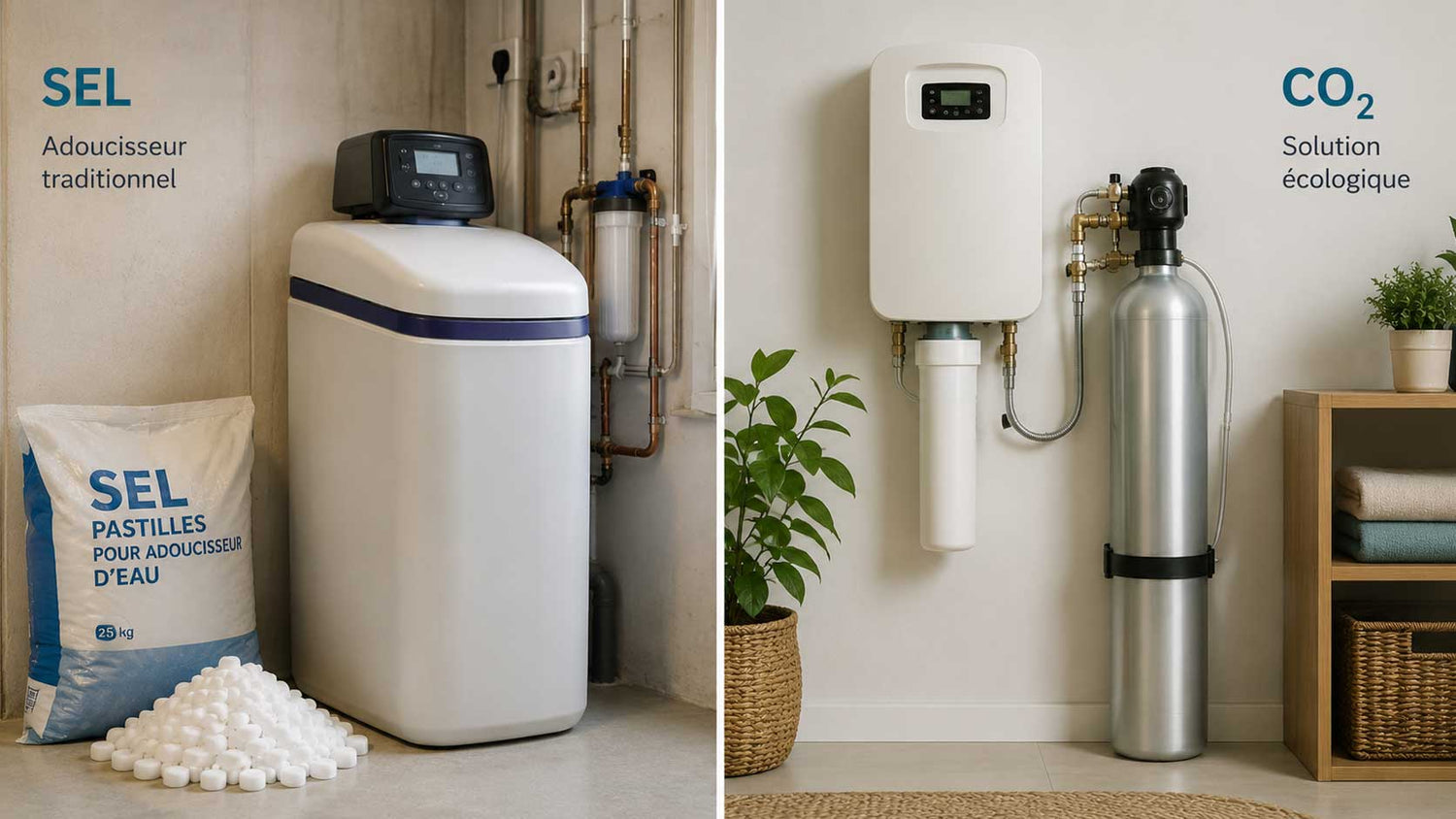
Salt softeners and CO₂ softeners both aim to reduce limescale in water by removing excess calcium and magnesium responsible for scale deposits.
1. Classic Salt Softener
Process
Ion exchange
The salt softener is placed right at the main water inlet. Water passes through a compartment equipped with an ion-exchange resin charged with sodium. Calcium and magnesium ions — responsible for limescale — are captured by the resin, which in turn releases sodium ions.
Regeneration cycle
After some time, the resin becomes saturated with calcium and magnesium ions and depletes its sodium. It then loses its effectiveness and must be regenerated using a saline solution.
Rinsing water discharge
The water used for regeneration is salty and laden with dissolved minerals. It is discharged into wastewater — a salt softener therefore requires a connection to the drainage system.
For reference: a 20-liter resin softener discharges approximately 100 liters per regeneration cycle. With one cycle every 5 days (73 cycles/year), this represents approximately 7,300 liters of water discharged per year.
Advantages
- Effective reduction of limescale in water and installations — extends the lifespan of household appliances
- Softer skin and hair after showering
- Reduced consumption of detergents and household products
- Energy savings due to improved efficiency of heating equipment
Disadvantages
- Salt consumption and regular maintenance (recurring cost)
- Discharge of saline wastewater
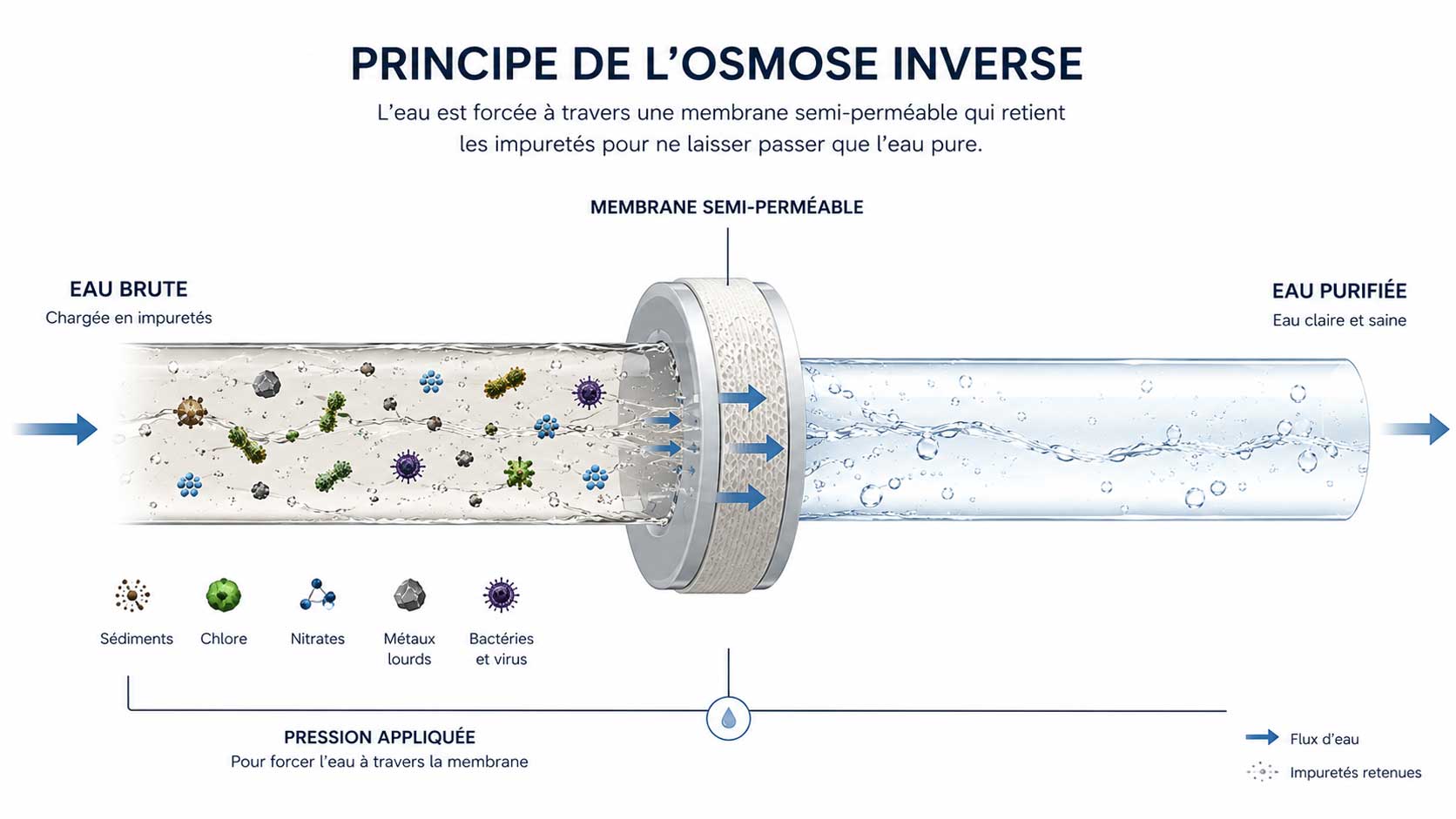
- Water can become too mineral-poor for drinking — the addition of an osmosis system with a remineralization cartridge is recommended
- Water that is too soft can promote corrosion of metal pipes
- Increased sodium content in the water
2. Ecological CO₂ Softener
A CO₂ softener is an ecological alternative to salt softeners for reducing limescale in water without altering its mineral composition.
Process
CO₂ injection into water
The softener is equipped with a regulator and a CO₂ cylinder, similar to those used for carbonating beverages. The gas is injected directly into the water as it enters the system.
Conversion of limescale into bicarbonates
Once dissolved in water, CO₂ reacts with calcium carbonate (CaCO₃) to produce calcium bicarbonates (Ca(HCO₃)₂) — which are soluble and non-depositing.
Unlike a salt softener, this system does not remove essential minerals such as calcium and magnesium, but prevents their precipitation as scale.
Advantages
- Ecological: no discharge of saline wastewater
- Easy maintenance: no salt to replenish
- Preserves minerals: water retains its calcium and magnesium
- Compatible with drinking water: no increase in sodium content
- Simple installation: connects directly to the main water inlet
Disadvantages
- Higher initial cost than a classic softener
- Requires CO₂ replenishment
- Does not completely reduce water hardness, but prevents scale formation
3. Which softener to choose?
Choose a salt softener if:
- You want completely softened, limescale-free water
- You accept more frequent maintenance and saline water discharge
- You have pipes suitable for softened water
Opt for a CO₂ softener if:
- You are looking for an ecological solution with no salt and minimal maintenance
- You want to retain beneficial minerals for health
- You want a simple and compact installation with reduced environmental impact
Environmental Impact
CO₂-based systems are generally considered more environmentally friendly: they do not produce brine, a byproduct of salt softeners that can harm aquatic ecosystems.
For pure drinking water in addition to your softener, discover our AquaCycle osmosis systems — with integrated remineralization cartridge.